
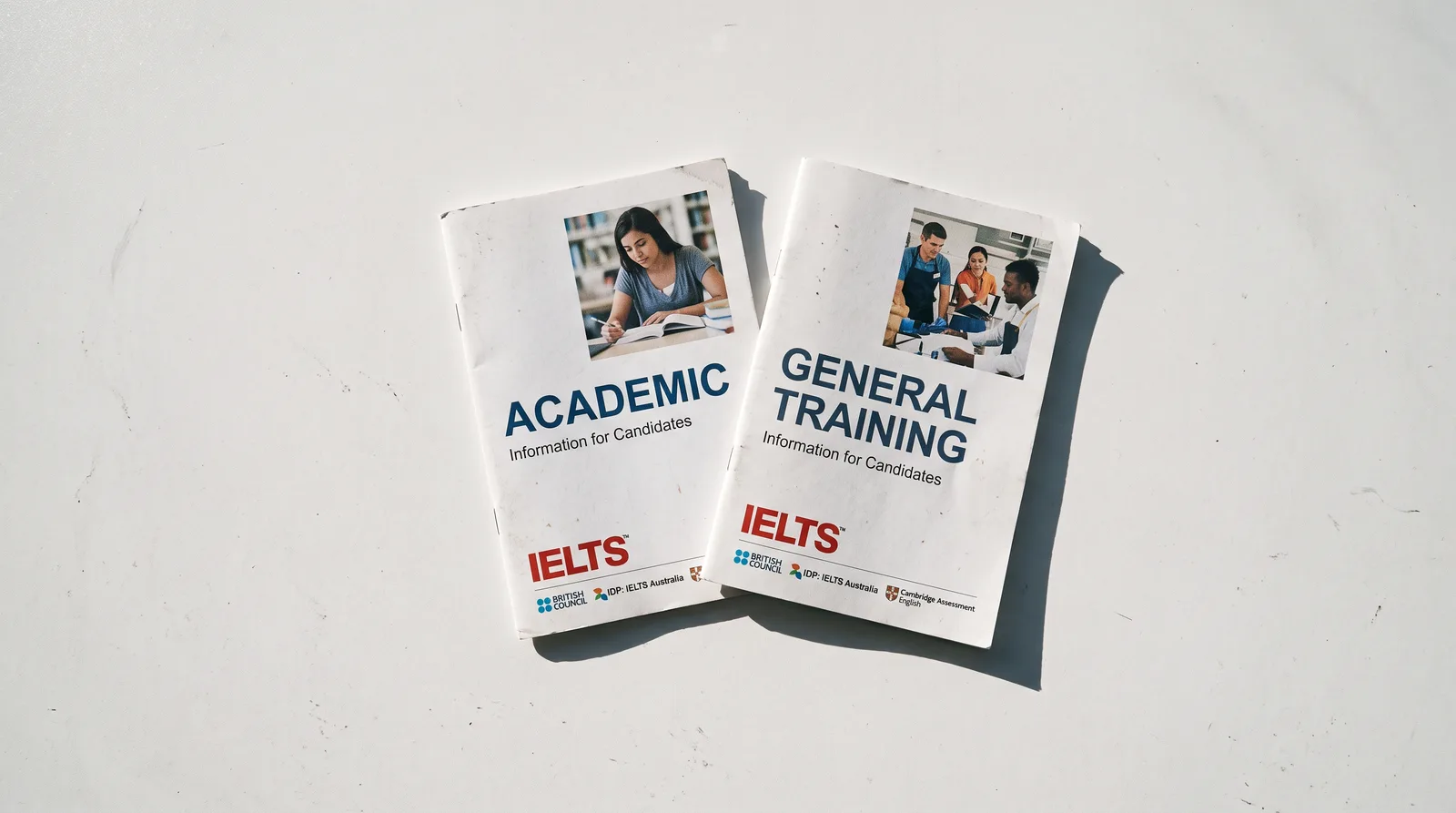
You've decided to take IELTS. Smart move. But before you book a test date or spend a single hour studying, you need to answer one question: Academic or General Training?
This is not a small detail. Sitting the wrong version means your score report won't be accepted — full stop. Universities won't accept General Training. Many immigration bodies won't accept Academic. Getting this right before you study is the single highest-leverage decision you'll make in your IELTS journey.
Let's break it down properly.
The Simple Rule for Choosing Your Version
Here it is, plain and clear:
- IELTS Academic → university admission, professional registration (nursing, medicine, engineering), and some highly skilled migration visas
- IELTS General Training → immigration pathways (US green card processes, Canadian Permanent Residency, Australian skilled migration, UK settlement visas), and work experience programs
If you're applying to a bachelor's, master's, or PhD program at a university, you almost certainly need Academic. If you're applying for a Canadian PR through Express Entry, a UK spouse visa, or US immigration-related purposes, you almost certainly need General Training.
When in doubt, go directly to the institution or immigration authority's website and read their requirements word for word. Don't rely on forums. Don't rely on a friend's experience. Read the source.
What's Actually Different Between the Two Tests
IELTS Academic and General Training share identical Listening and Speaking components. The same format, the same scoring, the same experience. The differences live entirely in Reading and Writing.
Reading: Same time, very different texts
Both versions give you 60 minutes and 40 questions. But the source material is worlds apart.
Academic Reading pulls from journals, academic publications, and research-style articles. The vocabulary is dense. The arguments are complex. You're expected to handle texts that a university student would encounter in their first semester.
General Training Reading is divided into sections. Earlier sections use everyday materials — advertisements, workplace notices, official documents. The final section moves toward a more extended text, but it still sits well below the Academic standard in terms of complexity.
This doesn't mean General Training is "easy" — the questions are designed to be equally challenging at the Band 6–7 range. But the nature of what you're reading is fundamentally different.
Writing: Same two tasks, completely different Task 1
Task 2 (the essay) is identical in both versions: 250 words minimum, an argumentative or discursive prompt, and the same marking criteria — Task Response, Coherence and Cohesion, Lexical Resource, Grammatical Range and Accuracy.
Task 1 is where the versions split completely.
- Academic Task 1: You describe a visual — a graph, chart, table, diagram, or map. You summarize trends, compare data, and describe a process. No personal opinion. Pure objective description. Minimum 150 words.
- General Training Task 1: You write a letter. It might be formal (a complaint to a company), semi-formal (a request to a manager), or informal (a note to a friend). You must match your tone to the scenario. Minimum 150 words.
These are genuinely different skills. Someone who has trained extensively for Academic Task 1 is not automatically ready for a General Training letter — and vice versa.
How Scoring Expectations Differ by Pathway
The IELTS band score scale (0–9) is the same across both versions, but the minimum scores required vary significantly depending on where you're applying.
For university admission (Academic): Most undergraduate programs at mid-tier US and Canadian universities ask for Band 6.0–6.5 overall, with no band below 6.0. Competitive graduate programs — think top-ranked MBA or law schools — often require 7.0–7.5 overall, with specific minimums in Writing and Speaking.
For Canadian PR (General Training): Under Express Entry's Federal Skilled Worker Program, a Canadian Language Benchmark (CLB) of 7 is the minimum threshold, which maps to approximately Band 6.0 across all four skills. Higher scores translate directly into more Comprehensive Ranking System (CRS) points — so every half-band you gain above the minimum has real, measurable immigration value.
For UK settlement and spouse visas (General Training): Requirements vary by visa category but commonly sit at Band 4.0–5.5 for settlement routes and Band 5.5–6.5 for skilled worker visas.
For US purposes: IELTS is increasingly accepted by USCIS as English evidence in certain petition processes. Institutional requirements vary, so always verify the specific band requirements for your petition type or institution.
The One Thing You Should Do Right Now
Go to the official website of the university, employer, or immigration authority you're applying to. Find their English language requirements page. Write down the exact version they require and the exact minimum score for each skill. Screenshot it.
That document becomes your target. Everything you study from this point forward is in service of hitting those numbers.
Choosing the right IELTS version is step one. Knowing exactly what each task demands of you — and building the specific skills to meet those demands efficiently — is where the real work begins. That's exactly what IELTS Mastery is built to help you do, from your very first practice session to test day.