
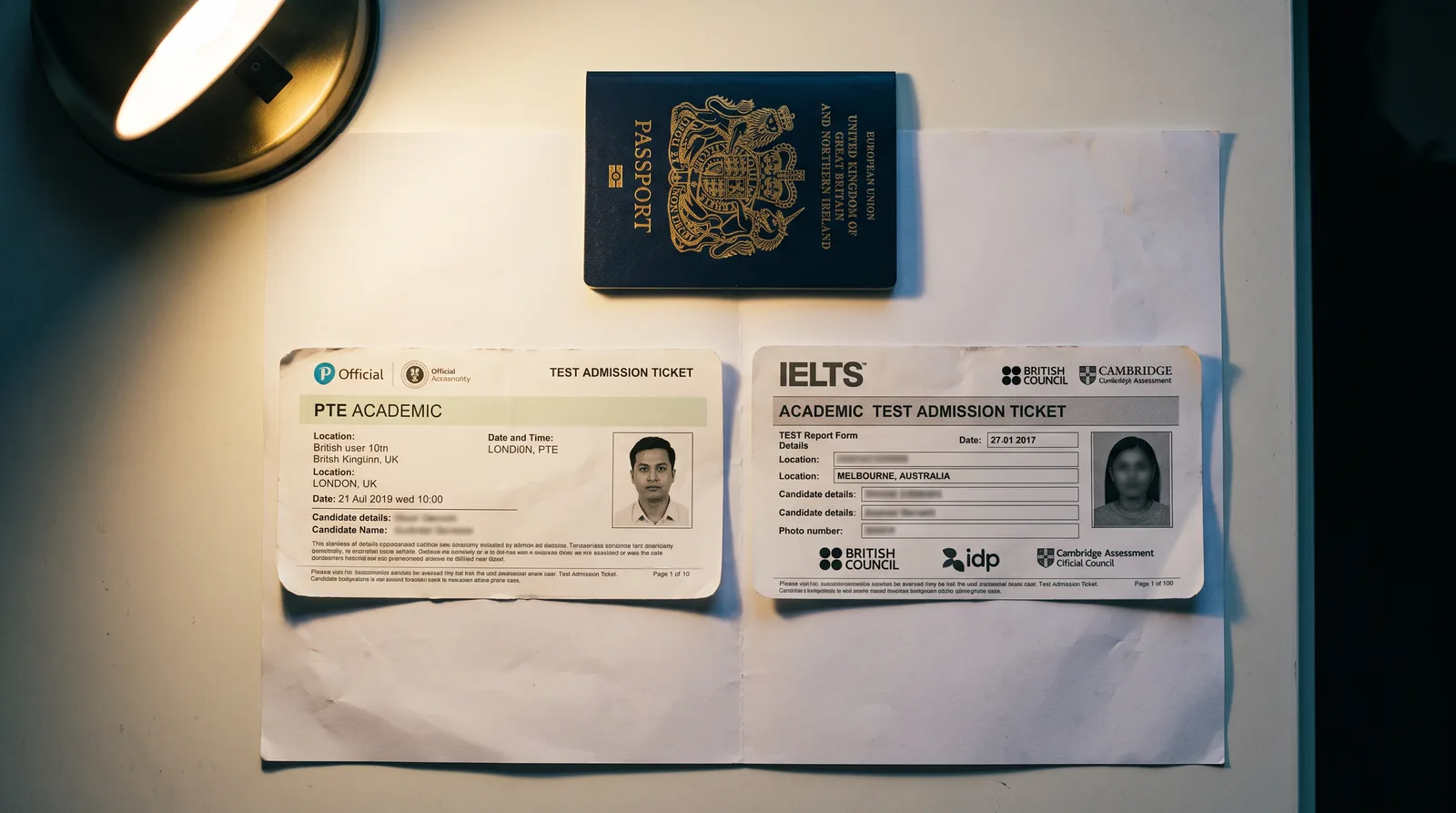
You've decided to prove your English proficiency. Now comes the question almost every test-taker Googles at midnight: PTE or IELTS?
Both are globally recognized. Both will open doors to universities, visas, and careers abroad. But they are genuinely different tests, and picking the wrong one can cost you time, money, and stress. This post gives you a straight-up comparison so you can make the call with confidence.
What Are These Tests, Actually?
PTE Academic (Pearson Test of English) is a fully computer-based test. You speak into a microphone, type your responses, and receive AI-generated scores — usually within 48 hours.
IELTS (International English Language System) comes in two formats: IELTS Academic and IELTS General Training. It's offered in both paper-based and computer-based versions, but its Speaking component is always a face-to-face interview with a certified human examiner.
Both tests assess the same four skills: Reading, Writing, Listening, and Speaking.
Format: How You Actually Sit the Test
The single biggest practical difference: if talking to a stranger makes you nervous, PTE removes that variable entirely. If you perform better in conversation than typing under pressure, IELTS Speaking may suit you more.
Scoring: Apples and Oranges
PTE reports scores on a scale of 10–90. IELTS reports band scores from 1–9, in 0.5 increments.
Here's a rough equivalency to keep in mind:
- PTE 65 ≈ IELTS 7.0
- PTE 79 ≈ IELTS 8.0
Neither scale is "easier." What changes is how you're assessed. PTE's AI scoring is completely consistent — it doesn't have a bad day, and it doesn't respond to charm or accent the way a human examiner might (consciously or not). IELTS Speaking, on the other hand, rewards natural conversational flow and coherent reasoning in ways that can actually benefit strong verbal communicators.
One important note: PTE scores are valid for 2 years. IELTS scores are also valid for 2 years. Check your target institution's requirements — some specify a validity window shorter than that.
Cost and Availability in 2026
In the US, both tests run in the $235–$265 USD range, depending on your test center and location. Prices shift by country, so always check the official Pearson and British Council/IDP websites for the exact fee where you're testing.
PTE availability is generally broader and more flexible. Because it's entirely computer-based, test centers can run sessions more frequently. You can often find a seat within days, not weeks — which matters enormously if you're racing a visa deadline.
IELTS has thousands of test centers worldwide, but popular locations fill up fast, particularly around university application season. Book at least 4–6 weeks ahead to be safe.
University and Visa Acceptance: The Real Question
This is where most people get stuck. Here's the honest picture:
IELTS has the longer track record and is accepted by virtually every English-speaking university and immigration authority worldwide — including UK Visas and Immigration (UKVI), Australian immigration (for both student and skilled worker visas), Canadian institutions, and US universities.
PTE Academic is accepted by thousands of universities and colleges globally, including in Australia, UK, US, Canada, and New Zealand. Australian immigration (the Department of Home Affairs) accepts PTE. So does the UK's UKVI for most visa categories.
Practical rule of thumb:
- Applying to Australian universities or going for an Australian visa? → PTE is widely embraced and often preferred.
- Applying to UK universities, US programs, or Canadian immigration? → Both work, but double-check each institution's specific requirements on their official admissions page.
Never assume. Spend 10 minutes on the admissions page of every institution you're applying to and confirm which tests — and which minimum scores — they accept.
So Which One Should You Choose?
Here's a simple decision framework:
- You hate face-to-face pressure → PTE
- You need results fast → PTE
- Your target school or visa only lists one test → that one
- You're a strong conversationalist → consider IELTS Speaking
- You're applying to Australia → PTE is a strong, well-accepted choice
- You want maximum flexibility across many countries → IELTS has the widest blanket recognition
There is no universally "easier" test. The right test is the one that plays to your strengths and meets your specific institutional requirements.
The Bottom Line
PTE and IELTS are both credible, respected, and genuinely useful qualifications. The decision isn't about which test is better — it's about which test is better for you, right now, for your specific goals in 2026.
Once you know which test you're taking, the next step is preparing strategically — understanding every task type, building your pacing, and practicing under real test conditions. That's where the real score gains happen.
Ready to start preparing? Explore PTE Master or IELTS Mastery and get a structured path to the score you need.