
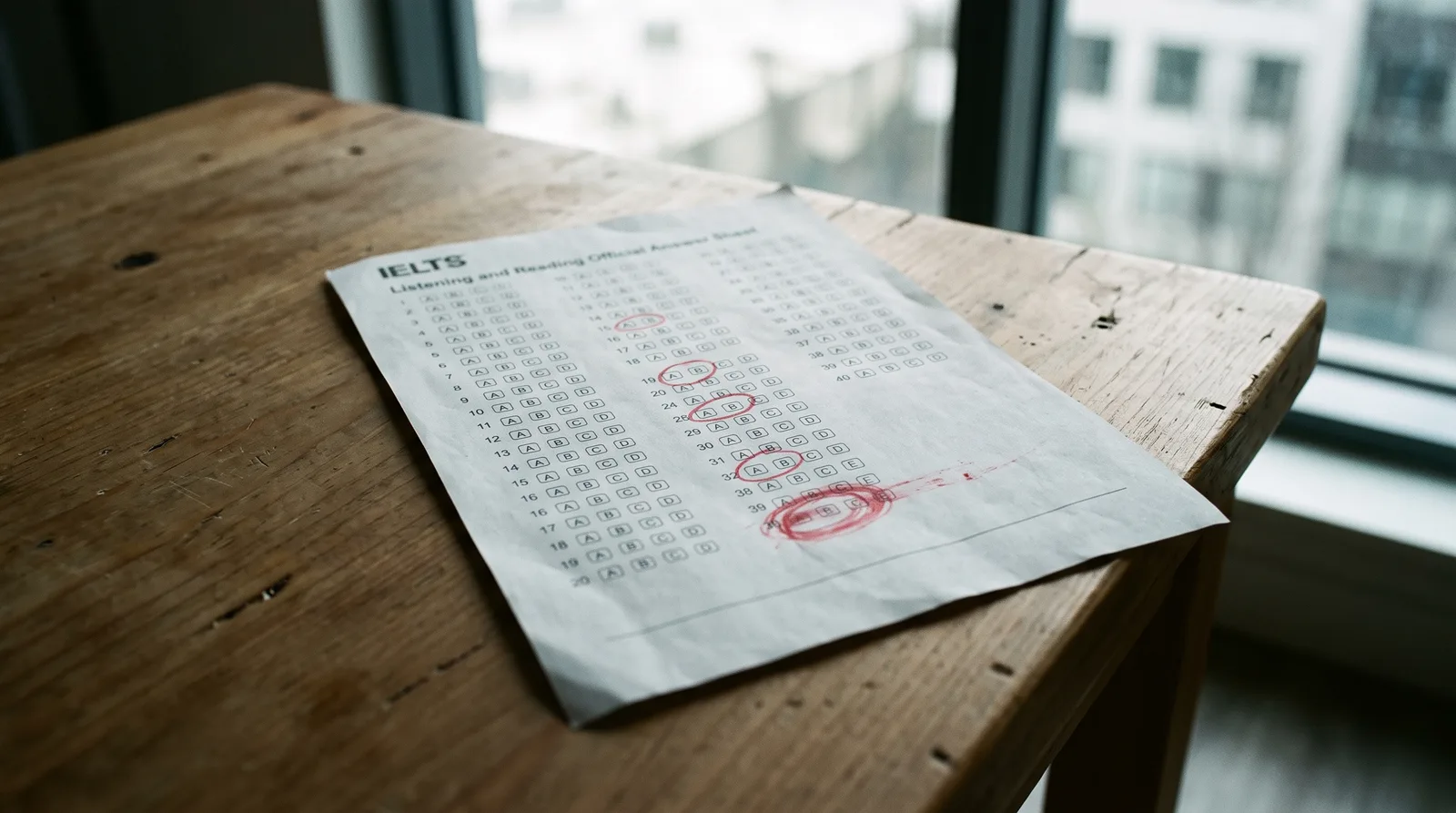
You can hold a fluent conversation, write a coherent email, and understand a podcast in English without subtitles — and still walk out of your first IELTS exam with a band score that doesn't reflect any of that. It happens constantly. The IELTS is not purely a test of English ability. It's a test of English ability within a very specific set of rules — and if you don't know the rules, you're giving away points before you even pick up your pencil.
Here are the five mistakes I see first-timers make most often, and the concrete fixes for each.
Mistake 1: Ignoring the Word Limit in Writing Tasks
Every IELTS Writing task comes with a minimum word count: 150 words for Task 1, 250 words for Task 2. Many test-takers either scrape right at the minimum or — more commonly — go dramatically over, thinking more words equals more marks.
The fix: The examiner isn't counting your effort; they're assessing your ability to communicate within constraints. Under the minimum? You're automatically penalized on Task Achievement. Way over? You risk introducing errors, losing coherence, and eating into your Speaking or Listening review time. Aim for 170–190 words on Task 1 and 270–290 words on Task 2. Practice writing to that range until it feels natural.
Mistake 2: Paraphrasing the Question Prompt Word-for-Word
In Writing Task 2, a huge number of beginners open their essay by copying the question prompt almost verbatim. The examiner can see the original question. Copying it signals that you couldn't paraphrase — and paraphrasing is directly assessed under Lexical Resource.
The fix: Before your exam, practice rewriting IELTS prompts using synonyms and restructured sentences. If the prompt says "Many people believe that social media has a negative impact on society," your introduction might read: "The growing influence of platforms like Instagram and X has led some to argue that online social networks are doing more harm than good." Different words, same idea — that's what earns marks.
Mistake 3: Not Transferring Listening Answers Carefully
The IELTS Listening section gives you ten minutes at the end to transfer your answers to the answer sheet. First-timers often treat this as a formality. It isn't.
Spelling errors cost you the mark even if your answer is otherwise correct. Plural vs. singular matters. Writing "sheeps" when the answer is "sheep" is wrong. Writing a number as a word when the instructions say write a number (or vice versa) can also cost you.
The fix: During those ten transfer minutes, read every answer out loud in your head. Check spelling letter by letter for proper nouns and tricky words. Double-check that you've followed any specific formatting instructions in the question.
Mistake 4: Treating the Speaking Test Like a Conversation
The IELTS Speaking test is structured into three very different parts, and treating all three like casual small talk is a mistake. Part 2 — the long turn — requires you to speak for one to two minutes on a given topic using a cue card. Many test-takers ramble loosely or, worse, stop after 40 seconds because they think they've said enough.
The fix: Use the cue card. It's there for a reason — every bullet point on it is a prompt to keep you speaking. Structure your response: open with a clear statement, cover each bullet point with a specific detail, and close with a brief reflection. Aim to fill the full two minutes. Time yourself during practice. Fluency is rewarded; silence is not.
Mistake 5: Assuming Academic and General Training Are the Same Test
IELTS comes in two versions: Academic and General Training. They share the same Listening and Speaking components, but the Reading and Writing sections are different in content and, to some degree, in difficulty and focus. First-timers sometimes prepare using the wrong materials entirely.
The fix: Confirm which version your university, employer, or visa application requires before you buy a single prep book or take a single practice test. If you need Academic, your Writing Task 1 will involve describing a graph, chart, or diagram — not writing a letter, which is what General Training Task 1 requires. Using the right materials from day one means every hour of study is actually building toward your goal.
The Bigger Picture
None of these five mistakes have anything to do with grammar rules or vocabulary lists. They're all about knowing how the test works — and that knowledge is completely learnable before you ever sit in the exam room.
Every point you lose to a format mistake is a point you didn't have to lose. Fix the format first, then build your language skills on top of a solid foundation. That combination is what moves the needle on test day.
If you want to go deeper on every task type — with strategy, timed practice, and feedback — that's exactly what IELTS Mastery is built for.